The global landscape of digital communication is currently undergoing its most profound transformation since the inception of the World Wide Web. As we navigate through 2026, the integration of artificial intelligence for marketing has transitioned from a collection of experimental, disparate tools into a unified, networked infrastructure that defines the modern marketing value chain. At STB India (Small Town Brandits), we have observed that this evolution is not merely technological but structural, demanding a fundamental re-evaluation of how brands communicate, convert, and retain their audiences. The shift is characterized by a move away from selective tool usage toward “Agentic AI”—autonomous systems capable of orchestrating entire campaign lifecycles without constant human intervention.

The marketing paradigm of 2026 is governed by the collapse of traditional search engine optimization in favor of Generative Engine Optimization (GEO), the prioritization of first-party data as a creative engine, and a relentless focus on verifiable human experience to combat the saturation of AI-generated content. This blog explores the nuances of these shifts, providing a comprehensive roadmap for brands to leverage artificial intelligence for marketing while maintaining the authenticity and ROI-first philosophy that we at STB have championed for over a decade.
The Rise of Agentic Marketing Systems: From Assistance to Autonomy
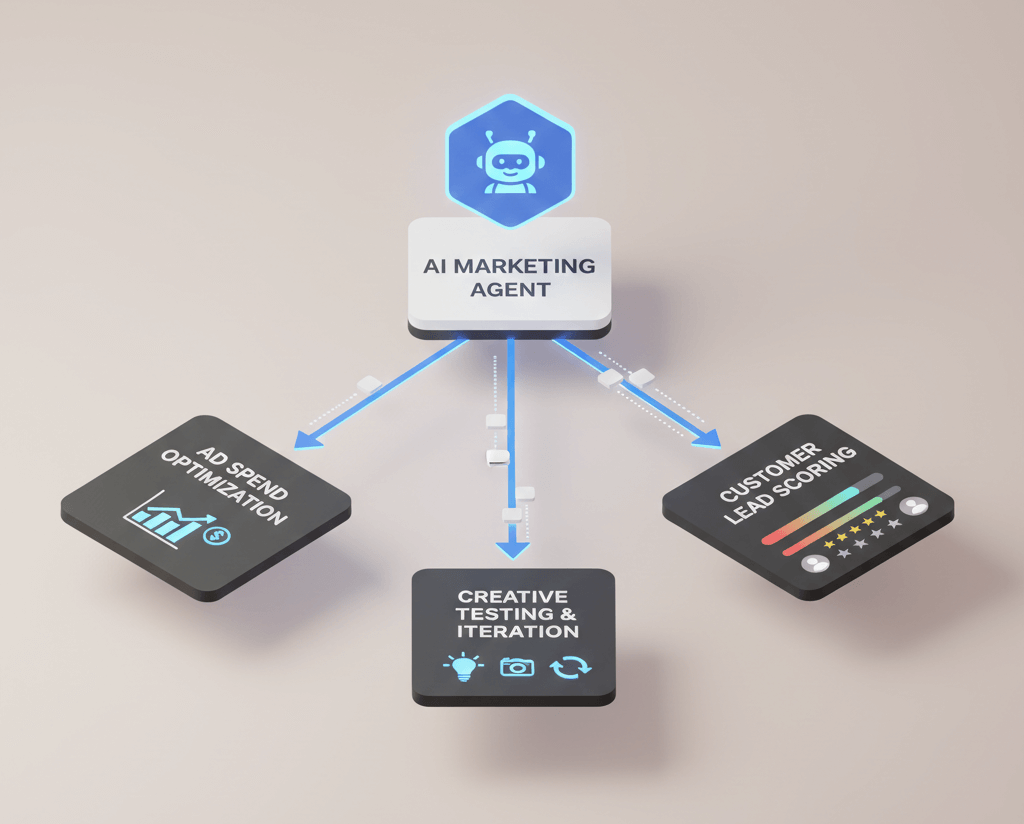
The most significant development in 2026 is the transition from assistive AI to agentic systems. In previous years, artificial intelligence for marketing functioned primarily as a high-speed assistant, requiring specific prompts to generate text, analyze data, or suggest keywords. Today, the focus has shifted toward networked AI systems that orchestrate entire marketing processes. These agents are capable of planning, acting, and adapting independently, functioning essentially as digital teammates that handle repetitive execution while human strategists focus on high-level creativity and brand governance.
The Mechanism of Agentic Orchestration
Agentic systems differ from traditional automation through their ability to simulate scenarios and act on predictive signals in real-time. For instance, an agentic campaign manager can independently propose campaign drafts, select target groups based on intent analysis, allocate budgets across channels, and continuously deactivate underperforming assets. At STB India, we utilize these agentic workflows to unify a brand’s voice across digital, traditional, and experiential platforms, ensuring that every touchpoint is optimized for maximum reach and engagement.
| Evolution Phase | Characteristics | Role of Human |
| Traditional Marketing | Manual execution, static planning | Executioner & Strategist |
| Assistive AI (2023-Today) | Generative tools, prompt-based | Operator & Prompt Engineer |
| Agentic AI (2025-Today) | Autonomous workflows, self-optimization | Strategist & Quality Controller |
The efficiency gains from this shift are quantifiable. According to research from BCG, the implementation of agentic AI can boost operational efficiency by 25% to 40%. This efficiency allows agencies like STB to focus on “hands-on interpretation”—setting the guardrails for tonality, brand fit, and legal compliance while the AI manages the high-frequency tasks of multivariate testing and media buying.
Agentic E-commerce and the Frictionless Journey
This autonomy extends into the transaction layer, giving rise to “Agentic E-commerce.” In this environment, digital agents negotiate, process payments, and handle complex customer service requests in real-time. For the consumer, this translates to a “conversational experience” that transcends the traditional static web page. Websites in 2026 are no longer digital catalogs; they are intelligent environments that recompose themselves based on the visitor’s intent, expertise, and behavior. We at STB emphasize that for a brand to thrive in this environment, its data must be “AI-readable,” utilizing structured formats and schema markup to ensure that buyer bots and shopping assistants can accurately interpret product specifications and service benefits.
Generative Engine Optimization (GEO): Navigating the Post-Search World
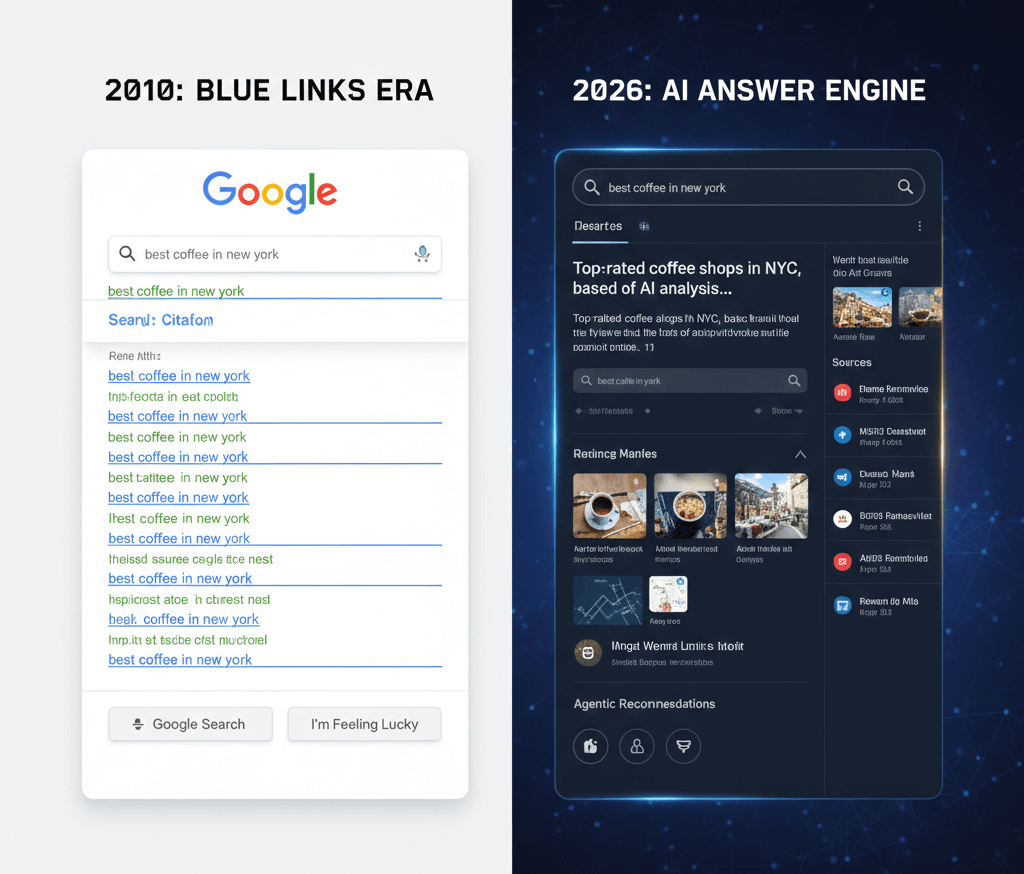
The traditional SEO playbook, centered on ranking in the “blue links” of search engine results pages (SERPs), has been on a decline. The rise of AI overviews in Google, alongside platforms like ChatGPT Search, Perplexity, and Bing Copilot, has fundamentally changed how users discover information. We are now in the era of “Search Everywhere Optimization,” where a brand’s visibility depends on being surfaced and cited by large language models (LLMs).
The Zero-Visit Visibility Challenge
One of the most disruptive aspects of GEO is the evolution of “zero-click” search into “zero-visit” visibility. AI engines often provide complete answers directly within the interface, reducing the necessity for a user to visit the brand’s website. While traditional organic click-through rates (CTR) can drop by as much as 70% in these scenarios, the quality of the remaining clicks has increased. Users who do click through from an AI summary arrive with a higher intent to act, as the AI has already provided the initial research and qualification.
| Feature | Traditional SEO | Generative Engine Optimization (GEO) |
| Primary Goal | High ranking in blue links | Being cited as a trusted source by AI |
| Content Focus | Keyword density, backlinks | Contextual depth, entity-rich data |
| User Intent | Matching search queries | Reducing user uncertainty |
| Metrics | Clicks, CTR, Impressions | Citations, AI Reach, Brand Sentiment |
Strategies for AI-Ready Websites
To compete in this new search reality, websites must be structured for ingestion by LLM crawlers like GPTBot, ClaudeBot, and Google-Extended. We at STB recommend several critical adjustments to ensure brand authority in the AI ecosystem:
- Concise, Insight-Led Summaries: Core pages should open with clear identity statements and summaries that AI models can easily absorb and cite.
- Structured Data and Schema: Using Schema.org markup for Organizations, Products, People, and FAQs is no longer optional. It provides the “roadmap” that AI engines use to connect entities and understand brand context.
- Layered Content Architecture: Content should be organized into topic clusters, with a central pillar page linking to detailed cluster pages. This architecture signals topical authority and expertise to search algorithms and AI models alike.
Performance Marketing and the ROI of Artificial Intelligence
Artificial intelligence for marketing has redefined the metrics of success, particularly in the realm of paid media. AI-powered campaign management now delivers 20% to 30% higher ROI compared to manual methods. At STB India, we have seen these results firsthand, particularly through AI-driven bid management and precision audience targeting, which have helped our clients achieve a 3-5X Return on Ad Spend (ROAS) and a significant reduction in customer acquisition costs.
Quantifying the Impact: The Nielsen-Google Case Study
A definitive study conducted by Nielsen in collaboration with Google quantified the bottom-line impact of AI across YouTube and Search. The study analyzed over 50,000 brand campaigns and 1 million performance campaigns, providing granular proof that AI is a performance driver, not just a planning tool.
| AI ad Solution | ROI/Effectiveness Gain |
| AI-Powered Video (YouTube) | 17% Higher ROAS |
| VRC + VVC (Synergy) | 23% Higher Sales Effectiveness |
| Demand Gen + P-Max | 10% Higher ROAS |
| Performance Max (vs. Search) | 8% Higher ROAS |
| Broad Match Keywords | 15% Higher ROAS |
These findings suggest that the “real magic” of artificial intelligence for marketing occurs when brands combine multiple AI solutions strategically. For example, using Broad Match in Search campaigns allows AI to identify valuable customers beyond exact keyword matches, while Performance Max optimizes conversions across all Google channels in real-time.
Mathematical Optimization of ROAS
The efficiency of AI in performance marketing can be expressed through the optimization of the Return on Ad Spend formula. If R$ is the revenue and S$ is the spend, AI focuses on maximizing the utility function of every rupee spent, i.e.. it enhances the probability of conversion by analyzing massive datasets of customer behavior, purchase history, and real-time intent, ensuring that ads are served to users at the exact moment of peak purchase probability. This level of precision is why 46% of businesses using AI report a significant boost in sales revenue.
E-E-A-T and the Trust Mandate: Experience as the Ultimate Differentiator
As AI-generated content floods the internet, Google’s E-E-A-T framework (Experience, Expertise, Authoritativeness, and Trustworthiness) has become the primary lens for evaluating quality. In 2026, “Experience” has emerged as the most critical factor. AI can synthesize information, but it cannot demonstrate first-hand, real-world involvement with a topic.
Verifiable Proof in 2026
To rank and be cited by AI engines, content must provide verifiable proof of experience. We at STB prioritize “experience-driven” content for our clients, which includes:
- Original Research and Data: Sharing proprietary insights from the Indian market, such as consumer behavior trends or industry-specific performance benchmarks.
- Detailed Case Studies: Documenting real customer journeys, including screenshots of results, project timelines, and authentic testimonials.
- Author Credibility: Ensuring every piece of content carries a byline from a real expert with visible credentials, LinkedIn profiles, and a history of professional contributions.
Combating AI Burnout
There is a growing consumer trend toward “AI fatigue.” About 20% of brands are expected to position themselves as “AI-free” by 2027 to highlight their authenticity. We believe that the winning strategy lies in a hybrid approach: using AI for scale and efficiency, but keeping humans “in the loop” for emotional storytelling, creative strategy, and ethical decisions. Trust is built when a brand shows its process—sharing behind-the-scenes content and personal narratives that resonate on a human level.
Strategic Content Production: The Multi-Modal Revolution
The use of artificial intelligence for marketing has revolutionized content pipelines, enabling a “hitherto barely achievable timing and variety of variants”. By 2026, content is no longer just about text; it is multi-modal, incorporating short-form video, motion graphics, and personalized visual assets.
AI-Supported Visual Storytelling
Visual platforms have become the core of the marketing stack. Short-form videos under 60 seconds (Reels, YouTube Shorts, TikTok) deliver the highest ROI for marketers in 2026. AI tools allow brands to produce these assets at scale. For example, a D2C fashion brand can use Leonardo.ai to generate hundreds of ad visuals in different styles, while Meta’s Advantage+ AI automatically reallocates the budget to the top-performing variations.
| Creative Task | AI Application | Human Role |
| Text Generation | Drafts, structural suggestions, localizations | Editor-in-Chief, Brand Voice Alignment |
| Visual Design | Logos, templates, layout resizing | Creative Director, Emotional Resonance |
| Video Production | Text-to-video, avatar-based explainers | Scriptwriting, Cultural Nuance |
| Social Media | High-frequency captions, hooks, hashtags | Community Engagement, Sentiment Analysis |
Content Engineering and Orchestration
At STB India, we view content creation as an engineering task. Instead of writing single articles, we build “trust ecosystems”—networks of interconnected assets that deepen credibility. AI aids this by “remixing” content across formats. A single deep-dive whitepaper can be transformed by AI into a dozen LinkedIn carousels, a series of short-form video scripts, and a personalized email sequence, all while maintaining strict brand consistency.
The Indian AI Landscape: Scaling from Pilots to Performance
India has reached a decisive turning point in AI adoption. In 2026, the conversation has moved past experimentation; 47% of Indian organizations are now operating multiple GenAI use cases live in production. This is supported by the “IndiaAI Mission,” a sovereign initiative backed by significant investment to build a self-reliant AI ecosystem.
Localized Innovations and SLMs
Indian enterprises are increasingly turning to Small Language Models (SLMs). Unlike massive global models, SLMs are efficient, cost-effective, and can be fine-tuned for Indian languages and cultural contexts. This is critical for brands aiming to reach the “Next Billion” users in India, where localized messaging and voice-based search are dominant.
We at STB recognize that the Indian market requires a unique blend of data-driven strategy and cultural depth. Our experience with over 150 global and local brands has shown that personalized, localized messaging outperforms generic campaigns every time.
Case Study: BYD SEAL and the Digital Powerhouse
The launch of the BYD SEAL in India serves as a benchmark for AI-integrated marketing. By combining high-performance electric vehicle technology with a robust digital strategy, BYD surpassed 1,000 bookings within just two months of launch.

- Mechanism: The campaign utilized a multi-platform approach, leveraging LinkedIn for corporate branding, Instagram for visual storytelling, and Instagram & TikTok for high-energy consumer engagement.
- Interactive Engagement: The “Spot the Dolphin” campaign encouraged users to post photos of the car using specific hashtags, creating an organic community of brand advocates.
- Result: This strategy not only maximized exposure but also converted interest into tangible sales, positioning BYD as a top car company in India’s luxury EV segment. We at STB believe that such results are only possible when technology is used to amplify, not replace, human creativity and strategic intent.
Data Intelligence and the First-Party Data Future
In an era of rising privacy concerns and the fading of third-party cookies, first-party data has become the most valuable asset in a marketer’s toolkit. Artificial intelligence for marketing allows brands to turn this raw data into “Decision Intelligence”—the ability to predict outcomes and inform resource allocation.
CRM Integration and Lead Scoring
Modern CRM systems are no longer just databases; they are “alive,” constantly updated by AI to provide a 360-degree view of the user. AI-driven lead scoring identifies high-value prospects by analyzing search trends, browsing behavior, and past interactions. This allows sales and marketing teams to prioritize their efforts on leads with the highest purchase probability, significantly reducing customer churn and increasing lifetime value (LTV).
By using AI to improve the retention rate, brands can exponentially increase their LTV. For example, predictive analytics can detect early signs of churn, triggering automated reactivation campaigns or personalized discounts to retain the customer.
The Role of Synthetic Data
Synthetic data is emerging as a powerful tool for testing and simulation. By creating simulated audiences, marketers can test ad creative and media strategies in a “risk-free” environment before committing actual budget. This allows for a 30% improvement in budget allocation by identifying which messages will resonate most with specific segments.
Conclusions and Actionable Insights
As we look toward the remainder of 2026, it is clear that artificial intelligence for marketing is no longer an “extra” tool—it is the default layer of the marketing stack. The brands that will dominate are those that move from manual execution to strategic orchestration, training and governing AI agents to act as an extension of their team.
Final Recommendations for Brands

- Prioritize AI-Readiness: Audit your website for AI crawlability. Add structured data to your core pages and rewrite intros to be clear and citation-friendly.
- Focus on “The Loop”: Implement a marketing infrastructure that connects creativity, automation, and analytics into one performance loop.
- Invest in Verifiable Authority: Don’t just produce content; produce proof. Share your proprietary data, your customer stories, and the faces of your experts.
- Embrace the Hybrid Model: Use AI for the “science” of marketing (data, scale, optimization) and humans for the “art” (emotion, strategy, ethics).
At STB India, we have spent 12+ years perfecting the balance between data-driven performance and seamless storytelling. As artificial intelligence for marketing continues to evolve, we remain committed to helping brands navigate this complex landscape, turning predictive insights into tangible growth. Whether you are scaling a D2C brand or an enterprise, the future belongs to those who lead with AI, not just follow it.







2 Responses
Great content! Keep up the good work!
Good a blog toper